
Part III: The Gateway Cup-Day Four-Giro Della Montagna, Or, the Worst 24 Minutes of My Life.
—Digression Coming Up!—
First, a tech treat:
Several readers have asked the Street Theorist about pics and vids. All the questions were the same: How in the hell do you get such unbelievable shots?
Without fooling anybody, I think that it is safe to say that I posses above average image-tracking capabilities. Besides my footwork and my stamina, I think a lot of my talent has to do with my equipment and my full understanding of my gear (I am a gearhead after all).
Well, here is my camera.
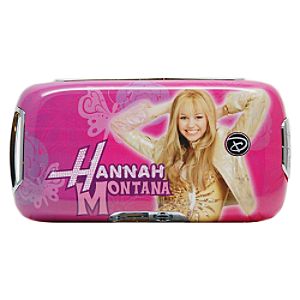
It is digital, of course—“bien sur” as they say in Canada! Can you believe I picked up this hi-tech rig in a bargain bin outside of Wolf Camera…with warranty (some clerk must have placed it there by accident).
And here is my video camera. I know it looks bulky, but it is deceptively lightweight and portable (probably because of all the stealth carbon).

As much as I love the HM, I think I am ready to step it up a notch. What I want is the new Samson Zoom Q3 Videocam.

If Zoom wants to sponsor this blog, then they should contact me quickly (I heard the Jonas Brothers Cutiepix line is about to hit the shelves).
—-Exit from Digression—
But this is really about racing, not photographing. Let’s get one thing straight, I am a racer and today, I am racing.
I warmed up on my trainer for a solid 30 minutes. Got the blood and sweat going pretty good. Then I pinned on the number and pedaled to the course. The men’s 40+ 50+ were still out on the course with one lap to go. I watched them strain by. When I heard that the race was over, I got onto the course, rode around corner four, and there, right on the corner, I saw two riders not only crashed, but still laying on top of a large rock (why is there a rock right there?). Almost like they were posing on the rock with painful smiles! They were moving, but scraped up for sure. Nice to see this as I roll up to the line.
When I get to the line I notice more chaos that usual. It seems a rider is down near the finish line. Everybody is squeezed to the side of the course to let emergency vehicles through. Very quiet.
I see an All-Nine-Yards rider and talk to him. Steve is an Iowan too, so of course we bond. He asks me if I saw what happened. No, I say. Then he drops the bomb: “do you know Dominic Moraniec? He rides for Atlas Cycling (based out of Iowa City).
Gulp.
Yes, I do know Dominic. Not personally, but I see him in all the regional races. Steve’s friend comes over in tears to tell us that his left shoulder is really banged up, but he is conscious. The ambulance leaves. And then, as crazy as this seems, the announcer calls my race to the line as if we are going to race even though we just saw what could come of racing! I wish Steve good luck and as the riders move forward, I move backward. The whistle blows and I look behind me: nobody. I am not only the last rider in the race of 110 riders, I am behind the last line. The caboose. Le lantern rouge.
After a few laps, I decide to, uh, practice the corners on my own. My mental game was so dismantled, so thoroughly crushed, that I could not mix it up. It’s not like I quit. Instead, it is more like I said to myself: under no circumstances can you pull out of the race and under no circumstances can you go down. So, in order to keep it rubber side up, I just twiddled at the back.
Now the back is not the best place to be if you want to finish a crit. Into each corner: brake hard. Out of each corner: sprint like the dickens. After 12 minutes of that, I was clobbered. So, I drifted off 6 feet, then 10 feet, then the elastic snaps.
I decided to work on my cornering skills until the refs pulled me…but they don’t pull me. After I figure that I have had enough corner practice, I hit the showers.
After the race, I felt a little flat:

I accomplished my goals: entered the race; no crashes. Called my buddy Dwight and we had dinner at the Slowest Restaurant In The World: Mama Campisi’s-On The Hill. Good food, great location, but it did take us a million and a half years to get served.
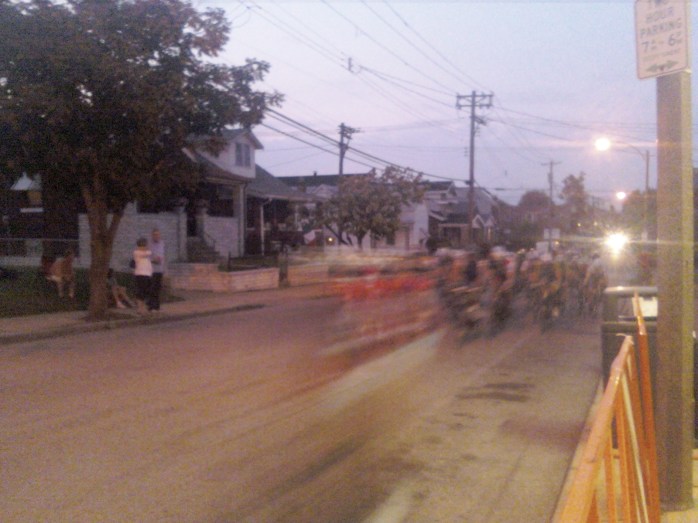
The food arrived in the middle of the men’s pro-1-2 race. The good thing about our location was that it was not on the finishing straight so we could not hear the crashes and we could not hear the booming announcer. Just the hum of the wheels zipping by.
Here’s another quick vid looking at Mama’s:
By the time the race ended, it was completely dark, the street lights were on, and Dwight and I had finished our food and wine.
It was a quiet end to a rough day for many racers.
END NOTES:
1. Today, September 15, I talked to Dominic. He is now in the Burlington (Iowa) Hospital. Although his life was never in too much danger, he did lose a lot of blood right after the crash, and his left shoulder is going to take multiple surgeries to fix the broken bones (humerus, scapula) and reattach the muscles—and perhaps a year of rehab. I wish him a speedy recovery. I hope to see him at Jingle Cross in Iowa City in November—not on a bike though!
2. I met Adam Fuson, who is a racer from Cincinatti. He provided me with some fine bike racing philosophy. We were talking between races and I said that it was a miracle that more racers don’t crash in each race. He said, “no, that is completely the wrong way to think of crashing.” My summary of his crash philosophy: If you multiply the number of racers by the number of laps and the number of corners, you can actually see that most of the time nobody crashes. Even though racers could crash, they don’t always crash. Out of all the riders and possible places to crash, there are really very few crashes. Therefore, you should not focus on the few crashes at all, but on the moments of racing in which everything is going just fine. Crashing is an anomaly, a break in the smooth peacefulness of the criterium (okay this last sentence is all mine).
He is right. If I focus on the crashes, then I won’t ever race. If I focus on racing, then I might get faster.
3. When church got out at the quaint church right next to the finish line, the attendees got toasted ravs, beer, and then sat down at all the tables on the church patio and watched the race. How civilized. I took some fine pics, but closed my cell phone before saving them. I was using my HM camera up to this morning, but it ran out of battery juice.
4. Four riders from Liquigas were there to sign autographs and rub shoulders with all the Italian community in the St. Louis Hills neighborhood. I got sweet pics of Franco Pellizoti! But, again, I closed my cell phone before I saved the shots. Doh!
5. Notice that I did not mention any race results. It was one of those days in which I was not into results. Anyway, check out www.gatewaycup.com if your really need that kind of stuff.
Stay Tuned for Part IV: Tour of Missouri; Or, How Not To Get An Autograph!
GATEWAY CUP PART II: ST. LOUIS HILLS STAGE (REALLY MORE OF AN INCLINE)–WITH VIDEO
Hi Readers.
I was lucky enough to get an answer to the question posed in yesterday’s post. It was a question about a certain Marco Pantani finish in the Giro d’Italia. My stars must have been lined up because the answer was from Matt Rendell: the same Matt Rendell who wrote the book that I am sure goes into depth on that stage win: The Death of Marco Pantani: A Biography. The answer is at the end of my previous post.

If writers of this caliber are going to read my blog, then I’d better check fur spellung. I really liked Matt’s A Significant Other. Now, he can be assured that I will read his other books. And in case you were wondering what these other books might be… here they are:
Olympic Gangster: The Legend of Jose Beyaert – Cycling Champion, Fortune Hunter and Outlaw. Matt Rendell (Mainstream 2009–this just came out in July!).

Blazing Saddles: The Cruel and Unusual History of the Tour de France. Matt Rendell (Velo Press reissued-2008)
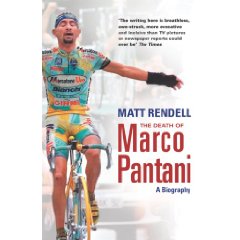
The Death of Marco Pantani: A Biography. Matt Rendell (Phoenix 2007)–see pic above.
A Significant Other: Riding the Centenary Tour de France with Lance Armstrong. Matt Rendell (Phoenix 2004).
The Official Tour de France Centennial 1903-2003. Edited by Matt Rendell and Nicolas Cheetham (Weidenfeld and Nicholson 2004).
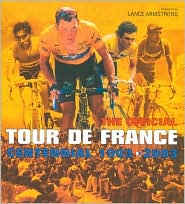
Kings of the Mountains: How Colombia’s Cycling Heroes Changed Their Nation’s History. Matt Rendell (Aurum Press 2003).

(If I missed any, please let me know)
On to the race report for the 2009 Gateway Cup.
Let’s start at the end. Click here for the results of the entire Gateway Cup. But even with this information, you keep reading. Why? Because it is the story that we want. We want information, details, and fleeting glimpses into the feeling of racing… a feeling that often boils down to degrees of pain. My friend Finn gave me this apt quote today: Pain is just the feeling of weakness leaving the body. Dunno who said this. Will track it down soon.
Let’s pick up one story then. Mine. I arrived late into St. Louis after a rain-soaked drive down 61 from Iowa City, Iowa, on Saturday, September 5, 2009. I thought that I had missed all the races, but luckily, the men’s pro-1-2 race started a bit late: I saw most of the race. This race was the “St. Louis Hills” stage in the Gateway Cup, the third stage. Even though each of the four races was a criterium, it was still a race that tracked each race and presented leaders’ jerseys for the rider with the lowest accumulated time (in the women’s and men’s pro-1-2 category; I am not sure if they had leaders’s jerseys for the other categories).
OBSERVATION #1: The course was a 1.3 mile, extremely wide and smoothly surfaced rectangle around Lafayette Park. Flat corners and only a moderate hill—more of a steady incline—running through the start/finish to corner #1.
This short vid of corner number 4 gives you a feel for the wide open course. The course is not perfect though. There were crashes (I didn’t see any but I did hear about them), and the hill wasn’t steep enough to cause real selections.
OBSERVATION #2: Great vibe! Everybody was friendly, from the racers to the crowds and even the announcer was nice. Wait, those guys are always nice. Why was the vibe so sweet? My best guess is that there are very relaxed open-container laws in St. Louis. For example, you could walk up to a host of tents along the course and get a selection of wine and beer. My favorite was the Bertolini’s tent which sold yummy toasted ravioli with grated parmesan cheese and marinara sauce. These snacks and sips were quite a civilized way to watch a bike race (hey Iowa, are you listening?).
OBSERVATION #3: The pro-1-2 field was alarmingly big. How many? 124. But when they are flying at you at 35 mph, it looks like 190 riders.
OBSERVATION #4: Noticed that my friend Brett was riding the tail-end race moto. It looked like a nicer gig than riding the lead moto because when a rider popped off the back, he could chat with him for a few seconds. Brett said that he has been in over 50 races this year as official moto. Way to go Brett!

OBSERVATION #5: Saw one of my teammates in the race! Duane Dickey. Well, he is not actually my teammate. We wear similar kits (Iowa City Cycling Club), but he is pro and I am a cat. 6 rider. Anyway the important thing was that he was REPRESENTING for the Iowa City Cycling Club (Go Smurfs!). The problem was, he was riding near the back, so I yelled encouraging words to him: “Hey Dewey, move up for love of God!” I think he listened because a couple of laps later he moved all the way up to the lead of the pack. Stupendous! Maybe I should become a cycling coach.
OBSERVATION #6: “Big Shark” is the name of a fantastic bike shop in St. Louis and they sponsor a decent bike team. In fact there were about 59 Big Shark riders in each race. No, that’s not accurate, but you get my point. They were stacking it. Dan Schmatz was their leader as he had won the previous night and was in the leader’s orange jersey.
OBSERVATION #7: Also saw Clark Priebe who rides for Sioux City Velo/Powerade. I like this rider as he put on a great show in the Iowa Criterium Championships where he got third. I think he is 44, and I like to see fast guys over 40 sticking it to the young punks. More on the topic of young punks later.
THE FINISH: With five laps to go a small break formed and finally, the race got exciting. A group of 5 pinched off the front. In one lap they got 8 seconds: Duane Dickey, Keith Harper, Jeff Hartman, and Brian Jensen. Because Keith and Jeff are Big Shark, their teammates got the front and put on the brakes. Brian Jensen is a formidable racer and I have seen him crush the entire field at the Iowa City Criterium before (2008), so, I was worried for Duane (who, as you might remember, got to the front because of my encouragement).
This group held about 8 seconds going into the final lap. I predicted that Brian would win. The announcer predicted that Brian would win. The crowd knows that this five-rider group will stay away. The course is too easy and too many Big Sharks are controlling the pack. Sewn up!


[Yes, these are a bit blurry. Hey, they are going fast, and I can’t get my stupid camera’s Fstop to reconfigure correctly. Operator error? Perhaps.]
But today held some surprises for sports fans all over the Midwest. For example, Northern Iowa University played the University of Iowa Hawkeyes in Iowa City today. The Hawkeyes were predicted to blow UNI out of the corn fields. But the UNI offense turned the defensive line of the Hawks into baby chick Hawklets. With only 25 seconds left in the game, the Hawkeyes were leading by 1 point and the UNI Panthers had the ball on the Hawk 30 yard line. The Panther kicker was reliable and it really looked as if the Panthers were going to win. A 40 yard attempt was well within the kicker’s range.
But for the first time in years, the Hawks blocked a field goal! Iowa was celebrating and going crazy. But then the whistle blew and a Panther had recovered the blocked football. In fact, the ball was blocked before the line of scrimmage, and so, and so, that meant that the Panthers had the ball and there was 1 (one!) second left. And they had another down left. Egads! This kick is the same distance. Surely the Hawks would not be able to block another kick, will they?
But they do block the second kick. The Hawks do win by one point. Hard to believe. I like the Hawks, but I also like an underdog. I was hard-pressed to choose which way I wanted that game to turn out.
And so it is in a similar vein that my own prediction of Brian Jensen stomping the gizzards of the other four riders does not come to pass. The pack catches the lead five and the sprint turns crazy, pell-mell, raucous, dangerous, cacaphonous.
I am in the wrong place to watch the sprint: near the top of the hill, looking down on the finish line. This is actually a scary place to watch the finish because the line of riders is skittering and lurching and lunging and flicking everywhere. Here is the pic that I came away with:

It may be the Worst Sports Pic of the Year. I will enter it into that contest next week. But wait a sec. Do you notice that an orange jersey is visible on the right side? Hmmmm! Well, that is Dan Schmatz! And he won the race. Ha. So my pic is not too awful. And do you notice a black and white kit near him? Cole House=#2.
As I learned a bit later, the finish was not as close as I imagined. Here is what went down from three different perspectives.
Brett: Brett was behind the race and saw the pack catch the five leaders on the backside of the course. He had just talked to Duane and asked him what happened. Duane said: “things looked good and then everybody started dicking around on the backside, and that was it.” (I realize some of this language might be a bit rough, but I ask for your patience, these are athletes under duress.).
Todd Campbell: When I walked by Todd, I did not know him, but he looked fairly pleased with his race and so I collared him like the aggressive journalist that I am. Todd races with Epic Bikes out of Kansas City. He said that he came in around 30th (a bit further back actually) and that it was a fine finish for him. He said that the last three corners made the entire race. He was well back with one lap to go, and then two things happened. First, he took some chances on the pancake flat corners and advanced a bunch of places with each corner. And second, the Sharks were getting tired at the front and they couldn’t contain the pack. The guys at the front were “blowing up right and left,” which made it easy to advance as along as you caught a kind wheel moving up instead of back.
During a lull in our conversation with Todd, we both looked over at Steve Tilford who was nearby (check his sweet blog here). “Oh, I know Steve” said Todd. “He did well. Maybe third.” I said that I had just come from the podium (the side of the podium really)

And I did not see Steve up there kissing the girls. Todd thought for a moment. “Perhaps he is contesting the finish.” How about that for some intrigue! [It turns out that Steve was fourth]. Todd was very nice for talking with me, and I hope he does well in the upcoming races.
Cole House (BMC U23) and Chad Hartley (Gear Grinder): Although they are on different teams, they travelled down from Wisconsin together, and they seem to be friends of some sort. Or, enemies that get along really well. Cole was second and Chad was third. It is hard to duplicate the ribbing that went on during the interview. While they would talk they would take turns interjecting a comment, usually a one word quip. Their favorite word, hands down, was “sketchy.” This term was liberally applied to riding, riders, ability, and everything else. They might have a future as a comedy team if the biking thing does not work out. But unless all of their legs suddenly were to fall off, that ain’t gonna happen. These guys have an excellent future ahead of them. In order to duplicate their cross-court verbal style, I have inserted their inserted words using parentheses.
Me: So, Cole, how [Chad: sketchy] did the final lap play out?
Cole: I saw it coming together as Big Shark [Chad: sketchy] were losing their lead guys and I also knew that I had [sketchy] to be near Dan’s [sketchy] wheel (Schmatz) because everybody was sure he would get the lead out for the sprint. I finally got to his wheel at the third corner, but then I lost it [Chad: naturally]. Then on the final stretch, I gained a few places but I could still see two riders in front of me. Dan and Chad. I was pretty lucky to just beat Chad at the line.
Me: So Chad, it seems that you launched early. Tell me about your finish [Cole: sketchy].
Chad: I had to go early today because yesterday I went too late. [note: yesterday, Cole was fourth and Chad was sixth]. When the catch was made on the backside I went [Cole: nnggguuh]. Caught and passed the remnants of the break and put my head down [Cole: sketch]. As I rounded the last corner I thought I might get it, but it was a long, long way to the finish. Slightly uphill.
These two guys gave the best interview I’ve ever had. We talked for over twenty minutes. We talked about Wisconsin, European racing, and the complexity of the U 23 system. Their directeur sportifs should bump up their pay and slot them to pro teams forthwith! (And by the way, Cole and Chad never finished outside of the top ten each of the four days of the Gateway Cup! As Finn would say, “they are so chronic,” which, for the uninitiated, means extremely good.)

I drove off feeling positively amped with excitement. I went to bed early because a big day of race lay ahead. And possibly, just possibly I might even enter a criterium. Drum roll please……my first crit in 4 (four!) years.
STAY TUNED TO THIS BLOG FOR THE NEXT INSTALLMENT: PART III; OR WHY IS THIS NUMBER PINNED TO MY JERSEY AND WHO ARE ALL THESE RIDERS TRYING TO KILL ME?
Peace,
Scraps
WHY WE RACE; or, an Introduction to The Gateway Cup in St. Louis
First Installment: Introduction and Some Street Theory

My goal is to write up a series of reports from this past weekend in which I watched a great deal of bike racing: The Gateway Cup and the first day of the Tour of Missouri. As with my Birkie Report, the aim is to grapple with the feel of the racing, rather than the clinical facts of who won.
So Scraps, why do we race?
Answer:
After the Pro-1-2’s race, day three of the four-day Gateway Cup, I saw something that I believe will go far in answering this question.
After the podium girls left the area, after the officials had posted results, only a few riders were around talking with friends and family, and I noticed that the course was still closed to traffic still. The street crews were probably tackling the back side of the course first. I also noticed that two girls were riding their bikes near the finish line. They were about 9 or 10 and I watched them for a few seconds and noticed that they were highly skilled riders. I walked to the barricades and watched them ride back and forth. Riding their 20” girl bmx bikes (Raleigh Cup Cake perhaps), they exhibited riding skills that informed me that the universe was not a bad place after all. I think that they were showing off for a lucky parent somewhere, or maybe just to practice their moves. First they would gain some speed with a few smart pedal strokes, then they would take their feet off the pedals and make circles in the air with their feet. The next pass, they kneeled on their seats. On the next pass, they crouched, feet on the seat. As I said: highly skilled. When they tried to stand up on their seats, I could hear a fatherly voice call to them: “girls!” And they would sit down obediently.
But the next few passes were even more astounding.
They would pedal a few strokes to gain momentum and then let go of the bars, arms outstretched wide, hands open, head tilted slightly back, and here is the kicker: their eyes were closed. And thusly, they would glide across the finish line, coasting.
It seemed to me that these girls had reached a state of grace in their biking. More than that (and what could be better than grace?), more than that, they were demonstrating what glory looks like. Not the glory of winning, but the glory of crossing the line—even when there is no race.
Why do we race? We race for moments of glory and grace…just like these two girls.
Sure, you may say that you race for money, for fitness, for your ego. True, true, and true. But you would be wrong in a larger, more theoretical sense. Remember, life is both real and theoretical at the same time. Example? Electricity and gravity are real, but you cannot see them. We create theoretical models of how they work, and for anybody who has fallen down, gravity sure does work. We negotiate the physical world and the world of ideas as they combine and tangle.
So, as I write about this race-packed weekend in St. Louis, keep this image in mind. This guy below may know what this feels like more than most. Cav won the first stage of the Tour of Missouri, but he did not have his eyes closed. But I am getting ahead of myself.
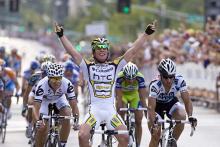
I think that Pantani has something to offer us as we investigate the idea of grace and glory. But surely was not on the mind of the young girls (unless their mom or dad is a cycling fanatic who continually watches 1997-1999 grand tour dvds). Yet I was struck by the similarity of the cool pose.

I might even read Matt Rendell’s book about Pantani to see if I can learn something. Worth a try.
 Bike riders and bike racers know so much about biking. But we don’t know it all. Sometimes we don’t know very much.
Tomorrow: Saturday’s final race: St. Louis Hills
Saddle Up! A Documentary Through Images of Bicycle Seats
Those who ride know this truism: three contact points guide your happiness whilst astride a bike. These points are, of course, the pedals, the handlebars, and the saddle. Today, I wish to present a personal documentary of my saddles, more of a pictomentary. Why is this so important? Because how and where you sit defines your existence!
The first saddle that I can remember was on my Ross kid’s 20″ bike. I was in the first grade, living in Wading River, New York (on “Lon Guy Land”). The bike was gold and I remember getting an after-market seat because I’ve always had a penchant for upgrading my gear. I do not have a pic of this seat, but I do remember the general design. Here it is:
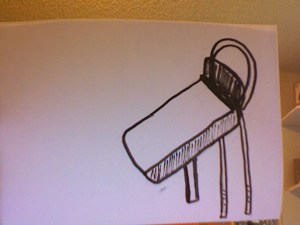
Notice how this seat is not even as ergonomic as a banana-style seat. Why did I chose this? Because I was in the first grade. What was I, maybe 12 years old or something like that. I could not make an informed decision. Not great for long rides, but I didn’t go on long rides.
My next machine was a Schwinn Le Tour. I loved this bike. Used to do laps around the local trailer park in St. Charles, Missouri. This seat was just as painful as the previous “brick.” I don’t have a pic of this either, but here is a red one (mine was blue) that is about 5 years older than mine. Squint and use your imagination:
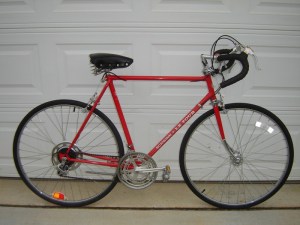
In high school, I started riding more seriously. I was introduced to racing by Chris from of Manchester, MA. I lived on the western edge of Gloucester, MA. He was my idol it is now safe to say. He was one of the best junior riders around. Rode for Richard Sachs! (which I too rode for eventually, but I was never really part of the clan, even though I wanted so much to be held tight in the arms of those “Connecticut Yankee”s–the best team around) He used to sneak into the pro fields at some races. I tried that once and lasted about 4 laps… Ah, those were the days when I was a teenager… ah those were the days when I can from my easy chair report back on all the fun I had and leave out all the terrible shit that occurred in between the blissful sporting moments. I started training seriously when I was about 15. I rode a heavy, flexy, sloppy Univega called, I think, Sport Tour. Its saving grace was a tan suede saddle (sorry no pic) and a sweet pearlescent creamy white paint job. It sucked. I worked some jobs, begged my rents for money and sold every baseball card and coin I had, and then I bought my dream bike: A 1984 Gios Super Record. Below is a pic, but not my pic. I did not rock the Selle San Marco Rolls. But beside my black Modolo Professional brakes, much of the rest is spot on-Campy throughout (except, also, for the Gipiemme cranks).
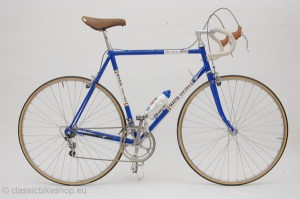
This picture is not how it looked though. Why not? Because I was always riding this chariot, this paean to grace and style. This bike classed up the entire town when I rode down Western Ave.
When I was on her, this is pretty much how I envisioned myself:
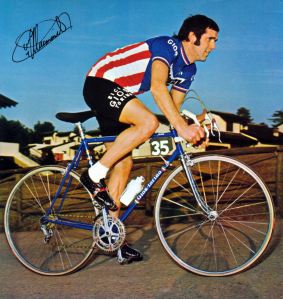
It took me about 6 months to finish piecing the bike together. Started with just the frame, fork, and headset. My saddle? Selle San Marco Concor. I think Chris had one. Alas, I don’t have the Gios with me any more (though it is still alive and well here in Iowa City since I sold it to a local guy looking to get into racing), but I do have the saddle.
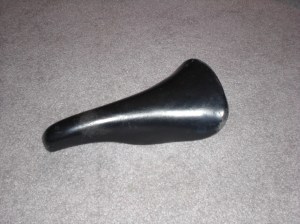
In fact I still rock the Concor today. I stuck it in on my Panasonic MC-5500 (triple-butted steel from 1997-ish). I hope it pleases you all that I have converted the Panasonic into a fine fully geared, fully fendered, and fully basketed towny.
When I got my Lemond Victoire in 2003-ish (about a million years ago it seems. God, do I want a new bike!), It came equiped with a very tiny Selle San Marco Era seat that never really worked with my “undercarriage”.

I swapped the Era a few years ago for light-weight seat, a Selle San Marco SKN, that may not be very sturdy, nor very well-made, but it seems to work for me. The reason it works and the reason that it is so light (185 g.) is because it has minimal padding, no leather, and Ti rails. The titanium rails (titanox?) and saddle flex quite a lot, but this is not a drawback. So, if you are the right weight, the seat really gets comfy the warmer it is and the more you break it in. On cold days, though, the flex doesn’t come into play and I am not so happy. And when it is really hot, over 90 say, then the seat is downright squishy. Yes, it is a fickle seat, but for most of the time it is just right. And if you are around 145-160, then I would give it a try. One other thing that I really like about this minimal seat (and a detail that separates this saddle from many other minimal ones) is the width (280 mm x 150 mm). It is much wider than my Era, and that means that I know that I need a bit wider saddle for my 5.10 height and 155 weight. My lorica cover is wearing off, but it has paid for itself over the past 3 years. Here it is (I would say ignore the cheap carbon seat post, but I actually think that it is integral to the flexy/sexy feel that makes the rig so sweet to ride):

My cross bike is another story, but it is a story that intersects with my Gios. I ride a used Bianchi Axis Cross bike (thanks for the deal, Thad). It came with an old Fizik Nisene.

The Fizik that I rode was silver though. I remember that during one February ride with my friends Lee, Jonah, and Josh, I complained about how hard my seat was. It was one of those awfully long gravel rides that was great for my endurance, but hard on my family life and also hard on my seat area. We were almost home when Lee said, “I’ll trade saddles with you if you want.”
“Okay, sounds fine. What are you riding Lee?”
“I have a Selle Italia of some sort.”
“Deal.” So we actually stopped on Melrose Avenue in Iowa City, and changed seats. This is a charming story except for the fact that Lee’s saddle was terrible. Needless to say I don’t have a picture of it, but I imagine that it looks something like this:

I bought a used Selle Italia Octavia to replace the Fizik. The Octavia was in a banged-up cardboard box filled with traded-out seats in Geoff’s Bike and Ski–got a great deal, like 29 bucks (when I want to emphasize a bargain, I always use the word “bucks” instead of “dollars”. As in: “Honey the carbon fiber wheels were only, like, 89 hundred bucks.” Try it… trust me.). But, is the Octavia a women’s seat or a man’s? I think they made a version for each. Anyway I liked it. For a while, anyway.
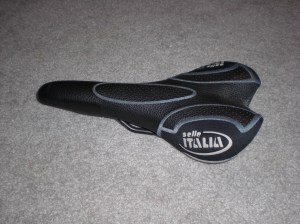
Then, suddenly, it started to hurt. Why? Too squishy in the wrong sector? So, for the past year I have been swapping the SKN between the Lemond and the Bianchi. Winter it goes to the Bianchi for gravel grinding. Summer to the Lemond.
Finally, I got a new seat for the Bianchi. The design of the SKN was not good for any cyclocross hop-on-and-off maneuvers (pointy points in the rear). Why? Cuz you can really hurt yourself in the worst of places. So, I shopped around for an inexpensive San Marco Rolls. Couldn’t afford. But I did find a very quirky deal on on a quirky Regal Ti.
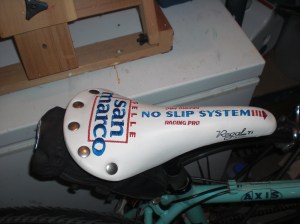
Only about 70 bucks for this white model that I have now rocked for a total of 92 miles (short gravel rides). Here are some kind details of the Regal:
The San Marco Regal is easy to distinguish from all other saddles at sight. It is a professional racing style saddle that begins with a molded nylon base. There are no depressions for extra padding at pelvic contact points. Over the shell is a molded, thin layer of high density expanded foam padding. Surrounding the foam pad and shell, a leather covering is glued. The Regal is available in a smooth Black, or White leather, and also perforated Black, or White leather, which gives a bit more air flow as the padding expands and contracts. The perforation process puts small, fine holes in a grid throughout the surface of the smooth leather before it is cut and cemented down to the padding and the shell. The leather around the nose is trimmed remarkably well using multiple cuts to give it a superior fit. On the tail of the saddle are six 5/8″ in diameter copper rivets. The rivets pass through the leather down through a second molded nylon piece on the underside. This second piece acts like a batten to hold the leather glued on the bottom of the tail even more firmly. This second nylon piece also has the rear rail receivers molded into it. The back of the rear rail receivers is molded for the copper “Regal Girardi” logos that are glued into it. Product Specifications Weight: 280g, Width: 150 mm, Length: 280 mm.
Like the reviews state, this saddle should not really work in terms of science or physiognomy.
Yet many pro riders still swear by it. So, I think I like, even though it is not (yet) as sweet as my San Marco SKN.
Peace,
Scraps
ps. for a while I borrowed my wife’s Serfas Curva. It was too soft. But I keep it around in case I need more cushion.
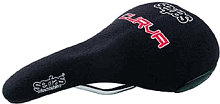
Since this contact area is clearly the most important, I wonder why there is not more discussion, or more documentaries on this subject? Is the subject too tender? Off limits? Perhaps.
Peace,
Scraps
TRANSITIONS and more of the same
Wassup Readers!….no. that doesn’t sound right.
Hello fellow streeters!…no. Too smarmy.
Sorry for the long silence!…yes, now that is getting more to the point. So why the big hiatus? Vacation for one. Job issues for two. And career issues for three. I realize that job and career are similar, but there is a difference worth theorizing.
You see, a job is something that you do for money, while a career is a job that you do for more money. Got it?
Now, my friends I don’t want to whine. So I won’t. But for a while I was under-utilized by the great academic machinery of this nation. I decided to take matters into my own hands.
And behold. I am now, once again, an entrepeneur!

This is my new logo for my new endeavor. We went online yesterday. Tomorrow is my first day at the office. Yes, I am worried about what to wear, but I will manage the big day with or without my wordsmithing vest. My pocket protector? I cannot do without my pocket protector.
What is Iowa City Wordsmiths? We offer writing, editing, proofreading, and tutoring services in Iowa City, Iowa– and around the world. Check it out for yourself at my brand new website designed with grace and style by Brown Wing Studio.
Peace.
Scraps
Beware Apple, Microsoft, The Atlantic, Google, PMLA and Others!
Why should these corporations/publications watch their step(s)? Because I am starting a company. And this company is associated with both publishing and technology…somewhat. Here’s a mock-up of my business card:

Word!
What is NANO? NANO stands for New American Notes Online. And the aim is to create a new type of journal of American criticism that is shorter, faster, and (most importantly) different. NANO will be the only academic journal (that I know of) that comes out monthy and has letters to the editor and has a twitter feed —which is currently up and running: http://twitter.com/nanocrit. The name NANO indicates small size and brief duration. What I like about the word nano is that it also connotes new technology that may change the shape of daily living. And NANO will, likewise, change the shape of American criticism.
More later.
Scraps.
Prepping For Travel
Seven Notes from the Street Theorist:
1. Do not use the word “freak” or “speed freak” when blogging because you will get spammed out the waazoo by nefarious entities. See previous post for my use of these two terms that I should not have used (again!).
2. I finally finished a group ride in Iowa City! Yes, it was the B ride, but still, I was active, and I felt like I was an actual bike rider. Actual as opposed to theoretical.
3. I am now just about at my fitness peak …and so what do I do? I go take a little vaca and waste it all. So, what’s the point? At least I will not be overtrained when I return.
4. Twitter is easier than blogging. Twitter is like Facebook on crank. Check me out: twitter.com/nanocrit. Or, I should say. Follow me.
5. According to my calender, Ferdi Kubler won the Tour in 1950. Who will win this year?
6. I picked up my tennis racket for the first time since I broke my wrist (on the bike, natch). Tennis is fun and easy. Much easier than riding a bike really fast.
7. No, I am not doing RAGBRAI this year. So I won’t be able to blog it sweetly.
peace. scraps.
Speed-Freak Scanlan Rides Again
I like what this Scanlan guy has to say, so read on and check’m out:

Preparing legs and liver for RAGBRAI with Tour de Brew biking and beer
BY ERIC ANDERSEN | JULY 09, 2009 7:21 AM
http://www.dailyiowan.com/2009/07/09/Arts/11986.html
And perhaps tomorrow, when I recover, you all street freaks can read about how I got served/swerved during tonight’s group race smack-down. High winds from the east? Check! A big group with lots of highly categorized riders? Check! One punkass street theorist ready to ride on the rivet? Check!
More tomorrow.
For now I need a beer.
Scraps (out)
Finally, Some Theory!
The word on the street is that my blog is turning into a biking blog.
Time to mix it up. Time to put some “Street Theory” back into this Street Theorist’s m.o.
This story begins with trash. I love my little cul de sac in the hinterlands of Iowa City. But I often find lots of trash in the street. I never see anybody littering, so who does it? I don’t sit on my stoop all day, so I can’t tell. Maybe kids are littering, or maybe the wind just blows it towards my house. One theory I had was that my neighbors’ kids were secretly littering. Yesterday I was pondering what to do about this trash problem, when I spied my neighbor walking on my portion of the sidewalk. Then I saw him bending down. Then I saw him pick up some litter and put it into a plastic bag. He went up and down both sides of the street. He stopped in my yard and looked at me. I waved. He waved. Then it dawned on me: he was glaring at me because he thought that my kids had been littering on his street.
Oh, a street theorist loves it when the tables are turned.
This brings me to a short excursion into ETHICS.
From my computer’s dictionary we find this explanation of the differing ways of interpreting ethics as a moral code of behavior:
Schools of ethics in Western philosophy can be divided, very roughly, into three sorts. The first, drawing on the work of Aristotle, holds that the virtues (such as justice, charity, and generosity) are dispositions to act in ways that benefit both the person possessing them and that person’s society. The second, defended particularly by Kant, makes the concept of duty central to morality: humans are bound, from a knowledge of their duty as rational beings, to obey the categorical imperative to respect other rational beings. Thirdly, utilitarianism asserts that the guiding principle of conduct should be the greatest happiness or benefit of the greatest number.
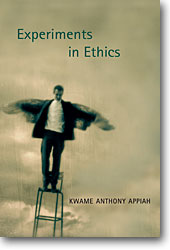
Below are some ideas (mixed with my own) from a recent book on ethics titled Experiments in Ethics by Kwame Anthony Appiah, Harvard University Press, 2008.
1. What we do depends upon how the world is–therefore we must understand how the world is–and so our everyday decisions can and must draw from many different spheres of knowledge. Based on this, I can reflect that I decided to get angry about the litter, but I did not decide to pick it up. What sphere did I draw from? The sphere that says blame the other dude, blame the government, blame big business, blame my parents, but above all else, do not blame myself. Wait! is this also called The American Spirit? Or, is that too sardonic?
2. In making choices we must start with a vision, however, inchoate, of what it means for human life to go well. This is via Aristotle in case you were wondering. What this means is that we do not make choices without some prior knowledge. In rather stark terms: we do not make decisions without some theory guiding it. Leave it to a to a street theorist to write that.
3. Not just politics, but also arts and sports are engaged in illuminating the present by drawing on the past. We make the future worth hoping for through frames of reference. If I am a biker, my frame of reference might be safety versus fun. I might stop during a ride to remove a tree branch from the bike lane because of my own past experience with tree branches. I put myself into the world of the future by remembering my place on the ground when I once went cartwheeling over a tree branch. What this means is that ethics are based on my desire to put myself into the possible event of being affected by the tree branch. Past and present are “smushed” together. I can decide to not stop and remove the tree branch–but that would mean that I have to pretend that I am not a biker, and not affected by tree branches. Basically, for me to decide to not remove the tree branch I have to pretend that I am not human. [Oh please, Street Theorist! This last one is too much! Perhaps.]
4. Our evaluations of the world around us are made through passions and emotions, not despite them. Feeling is thinking. When someone asks you to take your emotions out of the picture, they are asking you to think without thinking. Sure it may be best to not pull your hair out over every decision, but dispassionate logic is really thinking calmly, not thinking without any emotions. What this means is that you might be well served to bring your personality into the picture when making important decisions. When you hear someone say “it is not my problem that there is a tree branch in the bike lane,” you can respond in many ways. You can even decide to not respond. But by remaining silent, you have made a decision. And that decision, to be silent, is not an ethical choice. Why not? It does not pass the test. Not removing the branch may hurt you or others (Aristotle). It is not rational to your well being (Kant). And not removing the tree branch does not benefit the greatest number, just a small number, like maybe the clinic or bike shop that has to repair the damaged body/bike (Utilitarian).
Finally then, do you litter, pick up litter, or think about blaming somebody for the litter? Do you bunny-hop the tree branch, stop and pick up the tree branch, or write a blog entry about picking up a tree branch?
Aristotelians, Kantians, and Utilitarians all have points in their favor. But nobody has a lock on ethics. You must navigate through the litter and the tree branches.
Good luck.
Scraps.
NOW WITH VIDEO: Race Report: Iowa Criterium Championships in Cedar Rapids
What could be better than a bike race on a beautiful summer day in downtown Cedar Rapids, Iowa? That’s right: Nothing!
The course is a rectangle that crosses the Cedar River four times. How is that possible? Because the river splits around Mays Island, hence four bridges. The two bridges at the bottom of this pic were used.
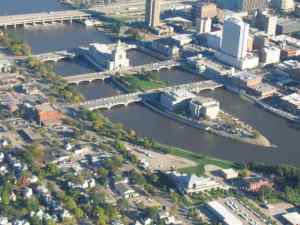
Besides the slight bowing of the bridges, the course is a pancake. The factors will be, as usual, the wind and the corners. The wind is not very strong, but still, it will be a factor when you are going at your max. Great corners (surface wise) and from what I heard, good surfaces throughout. That did not prevent all crashes, but I only heard of two: one in the master’s race and one in the men’s cat. 4 race.
WOMEN’S CATEGORY 1, 2, 3 RACE
I arrived during the women’s cat. 1, 2, 3 race. The field was very small, only about 13. And the funny thing was that it paid out to 15 places. Everybody wins something! The pack held together for most of the race. Robin Williams (ICCC) tried to break away, but was reeled in with about 5 laps to go. Kim Eppen (also ICCC) was nearly always at the front. I thought she might have enough to pull away during the last lap, but the other racers rudely used her and came around her in the sprint. Sorry that I don’t have the results for this race.
[note: this is a blog, not the New York Times. What this means is that I am not just a little biased, I am ultra biased: I don’t know everybody’s name, I only know a few cyclists from the Iowa City area, and I am not tethered to correct spelling. Sorry, sorry, and sorry.]
OUT OF ORDER: MEN’S SINGLE SPEED RACE
I was able to interview Matt Hartman (Atlas) after the single speed smackdown. There were only 5 racers, but still, not walk in the park. Matt said that he was just taking a moderate pull at the front of this 10 lap race when he noticed that he had a gap. “It was not an attack really,” said Matt, “it was more of a roll-away.” Continuing to ponder, Matt said that he didn’t intend the move: “I blame the rest of the group.” He decided to continue as the race was about half over. Then, on the last lap, Brian Eppen (ICCC) caught and passed Matt in a surprisingly quick manner. Still, Matt got second. Will (Bikes 2 You) was 3rd; Nick Martin (Atlas) 4; and somebody riding a Fuji (sorry no name yet) was fifth. I might mention that Brian was second in the master’s race. I might also mention that in the master’s race, he selected his single speed as his quiver, as his “WEppen” of choice. One wonders if a geared bike would have netted the win, or perhaps, a lesser placing.
MEN’S 4:
38 riders made for a big and exciting race. After a couple of flyers came to naught, the wind picked up a bit, and that kept the bunch rather bunched up. The pace and the corners whittled the field down to about 25. The last few laps got interesting.
With three laps to go, a rider burst out of the fourth corner and got a few seconds gap and another rider also had a few seconds on the pack. With two laps to go, one of these two riders who had a small gap was still off the front (the second guy I think). This rider off the front, Tim Putnam, looked big, strong, and smooth—although his face was a rictus of pain. As much of the course was open and flat, spectators could see him maintaining his lead of about 5 seconds through the corners. With one lap to go, Putnam had about 4 seconds—what, maybe 50 yards. The crowd went wild.
The suicide attack so rarely works, but when it does, it makes careers, it makes stories, it launches a hundred other copy-cat attacks too. How many times have we watched the lone rider in the Tour de France licking his stem with 10km. to go hoping against logic, hoping against history, to survive to the finish line. We watched Putnam grimace through the finish, one long lonely lap (.6 miles) trying to hold off the hungry pack that could see him the entire time. My guess is that nobody wanted to try to reach Tim alone, and nobody was fresh enough to try for the win off the front.
Rounding the last corner of the last lap, Putnam still had a lead, but it looked as if the pack was right behind him. The optical illusion of trying to figure out exactly how much daylight was between Putnam and the pack was a pickle. But I figured his lead was 30 feet. When the riders approached the line, I saw Putnam look back. Was he completely gassed, or was he looking to see if he had time to raise him arms?
And…a legend is born! Putnam held them off by about 20 feet at the line. A brilliant, gutsy move. Who doesn’t want this kind of win? I was able to track down the winner to get some insight. Putnam said that he was not confident of his sprint ability and the swerviness of many tired riders made him nervous. “I’m decent at time trials, and I did a bunch of cross-country skiing this winter, so I am in better shape,” said Putnam, smiling from ear to ear. Sorry I don’t have any pics of this glorious win.
Tim Putnam (North Iowa Spin) 1, Mike Hunter 2, Norbert K. 3 (Atlas), Jay Gorsh (Atlas) 4. Did I get these names right?
MEN’S CAT. 3 RACE:
About 33 riders took the line for this race. I was sorta hoping that the wind would continue to pick up because that would make for a very interesting race with echelons and tactics and blocking and all that noise. But the wind did not cooperate and died down.
My friend Brendan Kealey (ICCC) was amped for the race. Not everybody is able to rock the pink trainer with this much style.

After about 10 laps of only a few efforts to break up the sticky pack, I noticed one rider quickly established about 14 seconds—Derek Cassidy. Ouch, he looks smooth, I thought. This could be it. But then another rider took off to catch him, Jerome Rewerts. The catch is made and they work together. And they are gone. The race is sewn up tight.
These guys are big and strong. Two others get a gap after waffling for a bit. Ryan Jacobson (Atlas) and Brian Zinc finally break the elastic and solidify their lead over the pack. Ryan and Brian have 3rd and 4th locked. Then one other rider takes off in search of someone to take him in. But nothing doing. Poor Ryan French has to slog it out between Ryan and Brian and the pack, but he does hang on for a very hard fought 5th place.

My friend Brendan came in 10th, which is a good showing. He said that the pack was surging all the time so it was impossible to know which riders would get a gap and which ones would fail. So, of course, you have to stay near the front the entire race, and that costs you some “matches.”
What do I mean by matches? Well, each rider comes with a certain amount of matches that he or she can light during the race. These matches are metaphors for attacks or large efforts. For example, I usually pack about 3 matches on any given day. The guys who came in the top 5 of the men’s 3 race carry about 15 or so.
MEN’S PRO, 1, 2 RACE:
Talking Smack in the Smack Shack:

“This is just a workout. Hey, if I win, it’s just a bonus.”
“I hope for a really hard race, ‘cuz that helps me do well.”
“It will be very unlikely for me not to win.”
“A good goal for today is to lap the field two times.”
“I like chicken.”
The potency of these claims and this brio is one of the reasons that I could never reach the top ranks in this sport. Simply too much hard-core, knuckle-busting, spine-snapping competition for me. Too much of that killer-instinct for me.
Little Known Facts:
• Kenny Labbe was one of the announcers. He rode on the Postal team with Lance Armstrong for many years. Very nice guy and a great announcer—very informative.
• Brian Eppen decided to stick with what he knows: he will ride his single speed in his third race of the day.
• At least one 50 plus rider is in the field; at least two 40 plus riders are here as well.
• 21 riders line up. The race pays 20 deep.
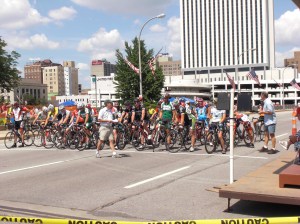
From the gun there are several attacks. Lee Venticher (Bikes to You) gets a few seconds, but is absorbed. Clark Grebbe (Poweraid) gets a few and is absorbed. He is always near the front. Paul Denninger gets a few and is then is absorbed.
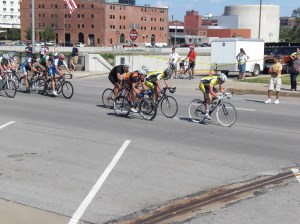
Clark goes again and is joined by one. Then next lap three more chase. Then these 5 are all together. This might be the break that sticks. The pack hesitates. And that is it! These five will contest for the win: Clark Grebbe, Brian Eppen, Sean Walker (Bikes 2 You), Jim Cochran (Atlas), Gerald Osterlof (All 9 Yards). Hope that I didn’t forget anybody.
With this break established, three riders go off the front in search of some glory: Dave Lippold, Brian Mortiz, and Paul Denninger. They will all stay away and hold their places (6-8). I can’t remember if Paul was 7 or 8 in the end.
The leading 5 lap the pack and since there are so many Bikes 2 You guys in the pack, I am sure that they will set things up for Sean Walker. It is hard to tell what is going on, because each lap shows new riders in the front.
Going into the last lap, the Bikes 2 You train is solid looking. But wait, it looks like Brian Eppen and Adam Price (ICCC) take off on the right and hit the first corner with some serious speed. I look on the back side of the course and it looks like Price is leading out Brian. But it must be too early to ramp it up, no? Everybody is single file now. One the backside, it looks like two Smurfs (ICCC) are followed by some Mellow Yellows (Bikes 2 You). Who is who? The Smurfs have maybe 12 feet between ‘em and another 12 between the Mellow Yellows.
They disappear behind corner 3. By corner 4 it looks as if they might be together. But wait. It looks like one Smurf and one Mellow Yellow are going at it as they near the line. Sean Walker and Brian Eppen. Does Eppen have a big enough gear? Will Walker come around him. Going to be close.
Eppen wins by a few feet! Too much. And on a single speed too! Stick that in your pipe and smoke it!

And here is a video of the last lap:
My friend Lee was nice enough to let me interview him after the race. His knee-length socks are red-white-and-blue numbers that nicely accent his pale legs very well. I’ll give him the last words:
Me: “So how was it? Any insight into team tactics?”
Lee: “That sucked.”
And there you have it.
But wait. I can’t let Lee have the last word. First, I want to say that this was a great event. I hope they have the crit championships here next year. I hope that downtown Cedar Rapids continues to rebuild after the flood (not many people were around, and few businesses were open). And while it may have sucked to have to race your ass off for an hour, it was really a splendid afternoon if you watch.
Thanks to HBA Racing for hosting this, especially Vern and Shirley Rotert and Larry Howe—the chief promoter. Thanks to all the racers and their families for supporting the fastest, coolest, most exciting sport in the world. Kim West might have some choice info on these races as he was an announcer, and as he has a radio cycling show, I need to give him a shout-out. Hey. Am-1460 KXNO (KXNO.com)
And thanks for reading.
Official result should be up soon at www.hbaracing.com
That’s the word on the street—
Scraps.
 Faster Skier-Nordic Ski Racing
- An error has occurred; the feed is probably down. Try again later.
Cycling News
- AusCycling special general meeting to go ahead after formal request from clubs but only one of four proposed motions will go to vote
- UAE Team Emirates-XRG forced to reduce race programme and change rosters after multiple crashes and Jhonatan Narváez, Tim Wellens among riders still out
- Are scientists now more important than star riders? Inside pro cycling's race for scientific innovation
- 'A killer sprint in the end' - Why a mad dash for Mid South Gravel victory shows a new generation has arrived
- How can a bike be faster in a crosswind? Explaining the sail effect in aerodynamics
- Sam Bennett to make long-awaited comeback from heart surgery this week
- 'Milan-San Remo is a scary race' – Tadej Pogačar reveals his fears and ambitions for Italian Monument
- Shimano to pay $11.5m penalty following crankset recall for failing to immediately report defect
- Tadej Pogačar supported by radically revamped UAE Team Emirates-XRG team for Milan-San Remo as he continues quest for victory
- Eddy Merckx offers advice to Tadej Pogačar on how to finally win Milan-San Remo, 50 years after taking record seventh title
 The Brooklyn Customizer: